

Transportation by air is the fastest way to deliver cargo between countries when deadlines, safety, and predictability are important. It is chosen for urgent deliveries, high-value goods, and cargo that is sensitive to time and storage conditions. Most often, transportation by air is used to transport electronics and components, pharmaceuticals and medical devices, samples and documentation, fashion collections, spare parts for production, perishable goods, and valuable cargo.
The key advantages are minimal transit time, high security levels, regular flights, transparent tracking, and just-in-time delivery option..
How SZMA Logistics organizes international air transportation
SZMA Logistics provides air freight services on a turnkey basis, from the initial request to the issuance of the cargo to the recipient. We structure the process so that the client understands what is happening at each stage and that the cargo moves forward without delays.
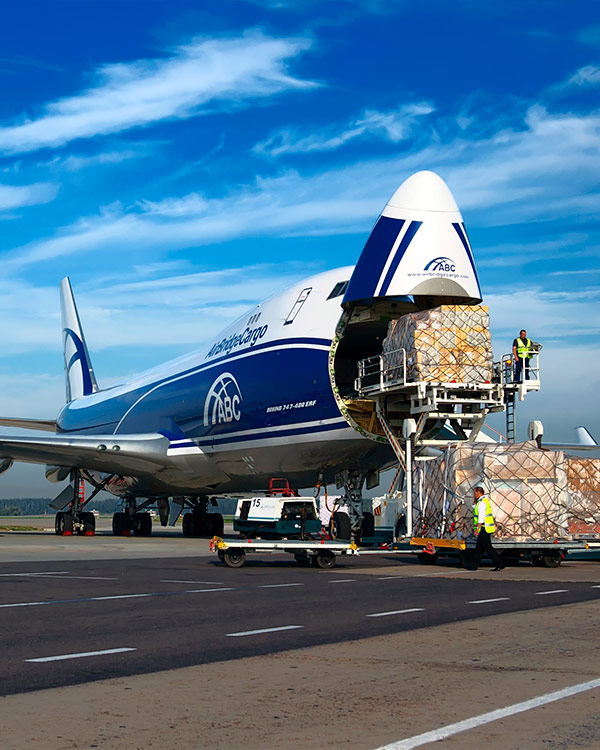
- We analyze the task: a route, deadlines, temperature/packaging requirements, size and hazards restrictions.
- We select the optimal scheme: departure/arrival airport, connections, cut-off time limits, "airport-to-airport" or "door-to-door" delivery options.
- We calculate the costs and time limits taking into account airfares, terminal fees, processing, and ground logistics.
SZMA Logistics prepares and verifies the documentation set to ensure smooth transportation at borders and terminals, without any delays. Depending on the route and type of cargo, this may include the following:
- Air waybill (AWB / HAWB)
- Invoice, Packing List
- Export/import declarations (depending on delivery terms)
- Certificates/permits (if required: of origin, of conformity, sanitary, phytosanitary, etc.)
- Dangerous Goods Reporting (DGR) documentation — for transporting batteries, chemicals, etc.
- Labeling and packaging instructions, airline and terminal requirements
We verify documentation data (weight/volume/codes/names/addresses) in advance to eliminate discrepancies that often lead to downtime and additional costs.
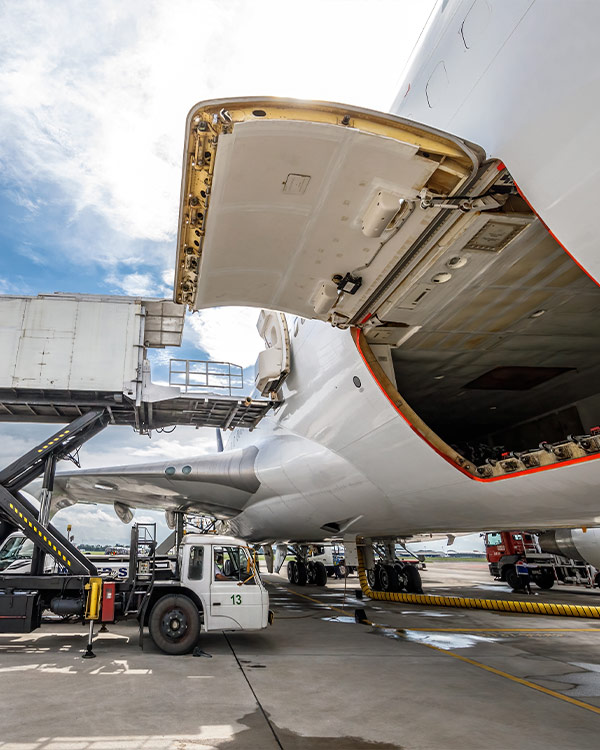
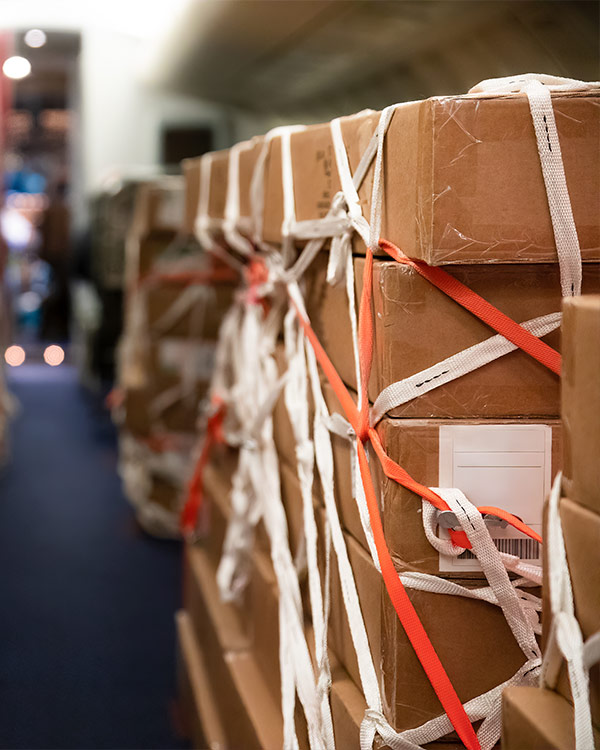
- We book a place on a flight through an airline/agent, agree on the fare and terms.
- We confirm the schedule, cut-off, the cargo delivery rules, the packaging and labeling requirements.
- We control the issuance of air waybills and the accuracy of data (weight, volume, description, codes, recipient/sender).
- We organize picking up cargo from the sender and delivery to the terminal (if required).
- We check the readiness of the cargo for transportation by air: packaging, palletizing, labeling, and compliance with weight and dimensions.
- We agree on storage conditions (including the temperature conditions) and the procedure for delivery to the warehouse/terminal.
- We provide terminal procedures and preparation for departure.
- We track the movement by AWB and the airline/terminal status.
- We promptly inform the cargo owner about the key events: acceptance for transportation, departure, transit, and arrival.
- We coordinate changes, if needed: flight rescheduling, reassignment, documentation adjustments, additional checks.
- We organize the receipt of cargo at the terminal and its subsequent delivery to the recipient's warehouse/door.
- We provide customs clearance (if included in the service).
- We control closing documents, delivery confirmations, and reconciliation of actual parameters and accruals.
- We assist with claims processing in non-standard situations (delays, damage, shortages) and the collection of proofing materials.
"The maximum weight and dimensions depend on the route, the aircraft type and the airline requirements. Cargo places of up to 80–150 kg are most often accepted for regular transportation, and pallet shipments are subject to agreement, up to several tons per pallet on wide-body flights. For oversized/heavy weight items, prior confirmation is required".
The main geography of Russian air cargo transportation and the way how transportation to Europe is handled under sanctions (via which hubs)
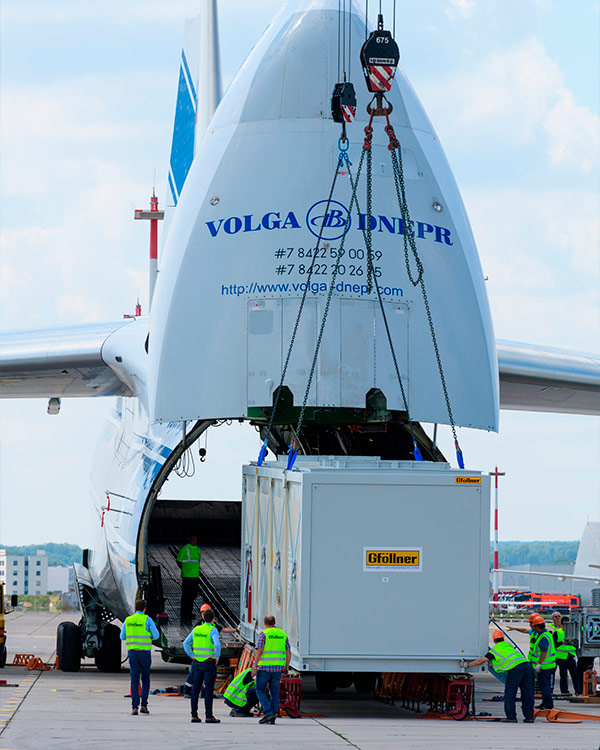
- China (all key industrial regions), Hong Kong as a trade and logistics hub.
- Turkey (Istanbul as a global hub).
- UAE (Dubai / Abu Dhabi as transit).
- Southeast Asia (Vietnam, Thailand, Malaysia, Singapore — often via hubs).
- India.
- CIS/EAEU (Kazakhstan, Armenia, Kyrgyzstan, Belarus — including as transit hauls).
- Middle East (Qatar, Bahrain, Saudi Arabia — to a limited extent).
Direct schemes are subject to current EU / individual country restrictions, airline policies and insurance. In practice, deliveries are often structured as multi-stage, with transit through neutral/friendly air hubs and a change of carrier / documentary circuit.
The most common transit hubs/nodes for connections to Europe (by market):
- Istanbul (IST) is one of the main bridges “Europe ↔ Middle East ↔ Russia/CIS”.
- Dubai (DXB/DWC) and Abu Dhabi (AUH) are major cargo hubs with an extensive network.
- Doha (DOH) is a major transit hub (availability depends on specific lines/policies).
- Belgrade (BEG) is sometimes used as an intermediary European hub (depending on current restrictions).
- Tbilisi (TBS), Yerevan (EVN), Baku (GYD), Almaty (ALA) are regional hubs for connections/transshipment (often in multimodal schemes).
How it usually looks like operationally (in general terms):
- Europe → hub (Turkey/UAE/Qatar/CIS) → Russia
- or Europe → hub → EAEU → Russia
- sometimes with a division into two air waybills (two AWBs) and/or a change of carrier on the transit haul, if required by compliance and the route.
Important note:
- Each shipment is checked for sanctions restrictions, export controls, final recipient, HS code, as well as the requirements of transit countries and airlines.
- It would be appropriate for SZMA Logistics to state: "We conduct sanctions/compliance screening and select a legal route".
Which aircraft are primarily used for commercial cargo air transportation?
Used for large lots, pallets/ULD, heavy loads, dangerous goods (subject to agreement).
- Boeing 747F (incl. 747-400F/747-8F), having one of the highest load capacity.
- Boeing 777F
- Boeing 767F
- Airbus A330F
- Airbus A300F (less frequently, but provided by individual operators)
- Il 76 (including regional/special flights)
- An 124 (rarely and for special projects, where available)
Often used for regular small/medium lots.
- A320/A321, B737 — regional/mid-range.
- A330, B777, B787, A350 — long-range (significant belly volume).
During certain periods, passenger aircrafts with increased cargo load are used (limited and according to the rules).
Interaction of SZMA Logistics with the cargo owner and the operator
With the cargo owner:
We establish requirements for time limits and conditions of transportation, collect initial cargo data, coordinate documentation and packaging, and provide clear status reporting and final delivery confirmations.
With the air transport operator / terminal:
Booking and confirmation of transportation, cut-off control, AWB processing, compliance with aviation requirements, supporting cargo at the terminals.
Commercial cargo allowed for air transport (typical categories + examples)
General Cargo
Transported without special conditions, unless they are subject to prohibitions/restrictions.
- clothing, footwear, textiles;
- automotive parts, components, hardware;
- household appliances, electronics (without prohibited batteries/kits);
- printed items, packaging, stationery.
Perishable products
Require compliance with temperature conditions / time limits.
- fresh fruits/vegetables, berries;
- chilled/frozen fish and seafood;
- meat products (subject to availability of veterinary documents);
- flowers, planting material (subject to availability of phytosanitary documents).
Pharma / Healthcare products
Often transported in a cold chain and with the packaging validation.
- vaccines/serums (with thermologgers);
- reagents for laboratories, test kits;
- consumables for clinics (catheters, syringes, bandage materials);
- medical equipment (ultrasound sensors, analyzers) — when properly packaged.
Valuable cargoes
Transported under increased security requirements (not all flights/airports accept it).
- precious metals (ingots/granules) and products;
- banknotes/coins (collection), securities;
- highly liquid electronics (smartphones / server components) — subject to agreement.
Fragile / Special Handling products
Require reinforced packaging and special labeling.
- glassware, ceramics;
- optics, instruments, measuring equipment;
- exhibition stands, models.
Live Animals — if this service is available
Not all carriers accept them; compliance with standards (cages, documents) is required.
- cats/dogs (commercial lots / kennels);
- aquarium fish (in special packaging);
- bees/insects (subject to agreement and the carrier's rules).
Dangerous Goods — are permitted while strictly following the regulations
This is not a "regular" shipment: it requires classification, packaging, labeling, declarations, trained personnel, and approval from the airline. Examples of typical DGs that are often transported when properly processed:
- paints/varnishes/solvents (flammable liquids);
- aerosols (cosmetics / technical aerosols);
- batteries/accumulators (lithium) — within the permitted scenarios (see prohibitions below);
- dry ice (for cooling, as DG).
Commercial cargoes prohibited for air transportation (or actually not accepted on scheduled flights)
Below are typical categories of products "prohibited" or "usually not accepted" because they are prohibited by regulations or are extremely restricted by airlines / airports / destination countries.
Explosive substances and items containing them (including ammunition) are generally prohibited
- cartridges, ammunition, primers;
- industrial/military explosives, detonators;
- pyrotechnics (fireworks, firecrackers) are usually prohibited on passenger and often on regular cargo airlines without special permits.
Transportation of weapons and their main components in commercial stream are often not available by regular air traffic
Even if it is possible in principle under special procedures, in practice it is often prohibited by the carrier/route.
- firearms, receivers, bolt action units;
- main parts of the weapon and controlled components;
- sights / thermal imagers may be subject to export controls / sanctions restrictions (especially for European destinations).
"Totally prohibited" dangerous goods, according to aviation regulations
- substances that are prohibited for transportation by air under any conditions (according to the classification of dangerous goods);
- chemicals that are liable to spontaneous combustion / explosion under normal transport conditions;
- unstable peroxides, some reagents.
(The specific list depends on the UN number and hazard class; shall be checked as per DGR/ICAO TI.)
Lithium batteries and accumulators are in some cases prohibited or severely restricted
The prohibition/restriction depends on the type (UN3480/UN3090, etc.), packaging and the route. Regular airlines often do not accept (or accept only by agreement) the following:
- lithium-ion batteries shipped separately (UN3480) — many carriers restrict them;
- lithium-metal batteries shipped separately (UN3090);
- damaged/defective/recalled batteries are generally prohibited.
Narcotic/psychotropic substances and precursors are prohibited without special licenses
- narcotic drugs and psychotropic substances;
- potent substances / precursors without permits;
- "gray" dietary supplements / pharmaceutical substances without confirmation of legality.
High-risk biological materials
- category A infectious materials (in most cases — only special transportation required, regular airlines often do not accept them);
- some pathogens/samples without permits and special packaging.
Counterfeit goods, goods produced in violation of IP, and goods with obvious sanctions risks
- counterfeit products (brand copies);
- goods subject to export controls / sanctions en route (especially when transiting through "sensitive" hubs).